REC0DED
A Future of Coded Identities
One of modern culture’s standout features is the representation of individual identity and freedom. Whether this is presented in the form of appearance, religious beliefs or creative expression, uniqueness shapes modern society. From avatars to online profiles, recent years have seen a shift in how humans present themselves. As social media and the internet take the world by storm, representing oneself has become even easier to navigate.
Humanities reliance on technology and machinery can be dated back to the stone age. From the simplistic mechanisms for agricultural and primitive activities to the broadly accessible resources we have today. Technology has transformed medical practices, by advancing genetic engineering, providing easier accessibility to research studies and the healthcare system that saves lives. With the use of mobile phones, emails and social media, technology has also improved accessibility to communication and made it more efficient. However, some areas of advancements have sparked debates around its supposed benefits. The creative industry is a broad spectrum of artistic fields and individual creators, linked closely to individualism and expression, the industry has been influencing human life and culture for centuries. Recent years have highlighted that the integration of AI and technology into creative fields are potentially ruining artists livelihoods and authentic creative expression.
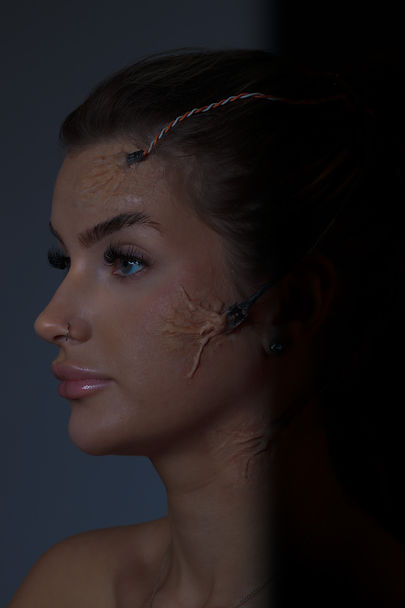
‘Recoded’ introduces the concept of human enslavement to technology, exploring how it’s integration is manipulating societal structures and values. Presenting a dystopian future, Lauren Kempe discusses key artists like Stelarc [insert other artists] to document an unbiased observation of the concept. She documents an emotional rollercoaster that encourages her audience to conclude their own opinions on whether the integration of AI and technology predicts humanity’s downfall. Looking at existing cinema like: The Matrix (1999-2021), WALL-E (2008) and Subservience (2024), ‘Recoded’ builds upon these narratives, but records a sentimental timeline of resurrecting one’s identity through reflection.
Research
Restraints of Reliance
Technology has transformed the modern era, presenting the nation with unlimited access to a range of resources. Despite its many benefits, some critics like David A. Scott, Bart Valley and Brooke A. Simeckae have found that as a society we have become too reliant on its uses. They also raise psychological concerns about how these addictions are impacting mental health for example: “Psychological issues related to the overuse of technology will continue to grow in the digital age…” [Scott, Valley and Simeckae, 2016]. As inventors continue to develop technology, the boundaries between human and machinery begin to blur, creating the future Frankenstein effect. This term relates to the development of a software or machinery that becomes uncontrollably sentient [Jain, 2021]. An example of this can be linked to Hanson Robotics 2016 project, Sophia. This robot demonstrated the possibilities of combining human identities and emotions into technology. While this example has yet to malfunction, recent years have seen multiple forms of AI begin to display rogue characteristics.

Artificial Intellegence

Artificial intelligence is one of the 21st century’s most significant technological advancements. Known for its human intelligence simulation – the machines have been adapted to learn, justify and perform tasks to assist everyday lives.
Artificial intelligence has evolved into a variety of prototypes including: virtual assistants, vehicles (Tesla) and data analysis. The programmes have vast abilities and accelerated information processors which enable short response times. As the usage of AI expands across industries such as: healthcare, finances, educations and entertainment – artificial intelligence has become integrated into the framework of our society. Recent years have seen a dramatic increase in the use of AI services – in a 2026 study conducted by Shubham Singh, sources of online AI bots like ChatGPT estimated around 900 million weekly users. Despite the many benefits these features hold, many critics hold negative predictions on the relationship with humanity.
There are two main circumstances of factors that affect human existence – environmental factors and existential factors. In the terms of environmental implications, artificial intelligence presents a paradox. Throughout the development of AI, thorough research and experimentation has and still is taking place. To train these machines, inventors have required immense energy consumption and large surface areas. Inevitably, increased power usage implements a higher carbon emission (which the planet is already struggling to combat) and the expansion of data centres contribute to electronic waste and landscape usage. On the other hand of this paradox, AI systems have the ability to monitor deforestation and predict climate patterns through analytics. While the two factors contradict themselves, it could be argued AI can benefit humanity in a theoretical sense.
The second area of concern stems from predictions of the long term risk for on the existence of humanity. In Chris Vallance BBC report, he reminds even the worries of ChatGPT software executive Sam Altman. Experts warn the public that the incorrect usage or development of AI systems, such as (AGI) artificial general intelligence, could surpass human intelligence and ability. While the majority of these predictions remain hypothetical, the March 2026 rogue Meta AI bot symbolises what could be possible. Similarly, there have been a variety of films including: 2001: A Space Odyssey (1968), I, Robot (2004), The Matrix (1999), M3GAN (2022) and Subservience (2024) that collectively communicate the potential threats of human-technology relationships. It is crucial that any future or current AI software align with human values and incentives to prevent disastrous outcomes coming in the future.


AI in the Creative Industry
The creative industry is a broad range of departments, each offering individual skillsets and ambitions, however in recent years there has been a collective concern around the integration of technology, specifically artificial intelligence. In an industry dominated by expression and uniqueness, AI has rewritten artistic possibilities and undermined the talents of such artists. In an ongoing debate, Refik Anadol has stood out as an advocate for the integration of AI. Within his work, he uses artificial intelligence to create AI structures – for example; in his piece, ‘A Sense of Healing’, he analyses brain activity and converts the information into a “mediative art”. Opposed to this narrative, the 2023 Hollywood labour strikes highlighted concerns about how employment would be maintained alongside machines who could offer a similar skillset, at a fraction of the cost [Halperin and Rosner, 2025]. I experimented with the use of AI as seen on the left. I created a comparison of a makeup look created entirely by hand compared to one with slight AI enhancements. I will leave to compose your own opinion of authentic or edited?

The Government Know Me More Than I Know Myself


Human Identity In a Digital World
As technology has evolved, it has become increasingly integrated into our everyday lives. From the mobile phones that we carry almost everywhere to the security cameras that mediate crime. Whilst many of us rely on technology to support daily tasks, large companies and governments have utilized these needs to their advantages. By using security systems like CCTV, the government have 24/7 access to the activities of their population. In China, the government has embedded facial recognition software into their surveillance systems to track and maintain its citizens [Raveloarison, 2025]. Within ‘Recoded’ there is a microchip implanted into the brain which allows for information retention and emotional stability. As seen in figure Image 10, the chip is paired with an avatar that recalls energy usage and medical advice. By incorporating this aspect, the project aims to explore how society has relied upon technology to explain their basic needs and give the medical advice. Similarly to the way digital footprints work, the project also outlines on a systematic tracking of individuals through said chips, predicting a world dictated by hierarchy
In a modern society, the digital world has rewritten tradition human components, as social media platforms have developed, the representation of one’s identity has become extremely self-explanatory. The term ‘digital identity’ refers to the online personas that individuals create of themselves, through social media pages, images, videos and online opinions [Ekinci, Dam and Buckle, 2025].
During the COVID-19 pandemic, social media platforms witnessed a dramatic increase in usage, as it acted as a tool to stay connected and communicate with loved ones. This popularity has continued to thrive in modern society, developing into a leading influence in styling and the latest trends. However, there have been a variety of concerns around the reality of digital personas, questioning the authenticity of filters and selective posting. The large increase in social media stars, has also introduced harsh beauty standards, stereotypes and multiplied mental health concerns [Ekinci, Dam and Buckle, 2025]– which has inevitably redefined traditional values of identity and self-expression.
Digital Identities (similar to physical surveillance) have also become increasingly used to monitor individuals. In 2003, the famous artist Hasan Elahi emerged with his transformative piece: Tracking Transience (2003). This project was in rebellion to the FBI’s wrongful accusation, claiming that he had partook in terrorist activities. Tracking Transience was originally met with confusion as during this period, as everyday lives were kept private – in contrast to the modern day in which he explains “And now, people look at me like, ‘I don't get it. What's the big deal? This looks like my Instagram feed.’” [Elahi, n.d].